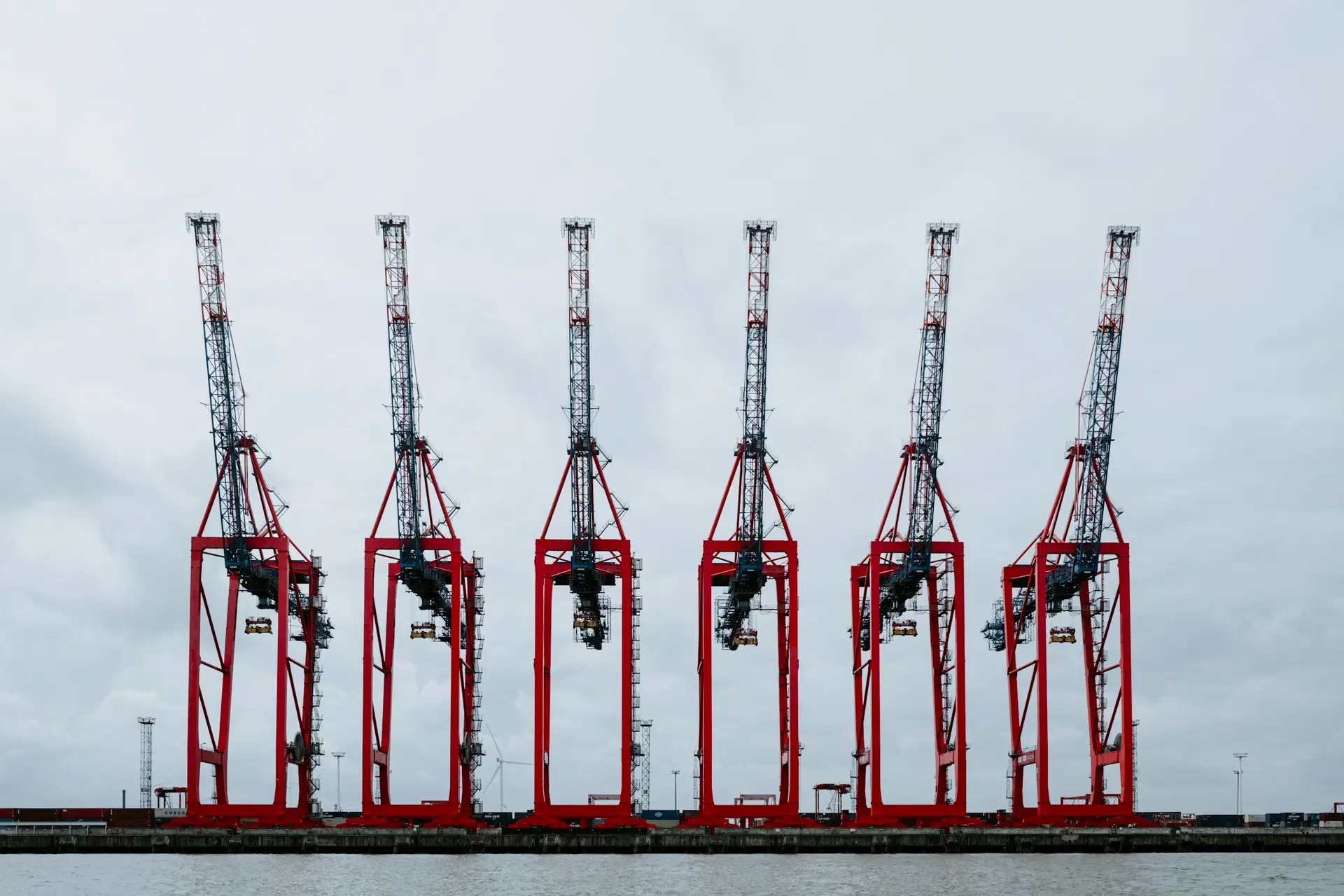
Cranes and yard equipment: ready when the ship arrives.
On a terminal, equipment must be available during port calls, and maintenance fits in between operations. Work on quay and yard equipment is scheduled between ship calls, and inspections are documented in dedicated forms.
What makes maintenance difficult in ports and terminals.
- 01
A schedule set by port calls
Loading and unloading operations set the schedule. Work orders must be ready for the windows when the machine is not in use.
- 02
A marine environment
Salt air, humidity and wind speed up the corrosion of structures, wire ropes and electrical equipment.
- 03
A large and varied fleet
Ship-to-shore cranes, mobile harbor cranes, straddle carriers, reach stackers and terminal tractors do not have the same components or the same inspections.
- 04
Inspections you need to find again
Wire ropes, spreaders, brakes and safety devices are examined regularly, and the results must be easy to retrieve.
The equipment your teams look after every day.
Every work order is linked to a piece of equipment. Its history builds up with each job carried out.
- Ship-to-shore cranesWire ropes, hoists, spreaders, boom and gantry travel.
- Mobile harbor cranesEngines, hydraulic circuits, slewing and lifting accessories.
- Yard cranes and straddle carriersWheels, steering, drives and twistlocks.
- Reach stackers and terminal tractorsTransmissions, brakes, masts and couplings.
- Bulk handling equipmentShip loaders, hoppers and conveyors.
- Quay installationsFenders, bollards, power supply and lighting.
How the team uses MatxFlow.
For each situation: what the team does in MatxFlow and what it can find afterwards.
A spreader shows a locking fault during a port call.
The operator reports the fault; the request is created on the machine, qualified and assigned as a priority.
The report, the machine concerned and the progress of the work.
A crane's wire ropes are examined regularly.
A form lists the inspection points, observations and photos, with a validation signature.
Inspections that can be compared from one examination to the next.
Maintenance must fit in between port calls.
Preventive work orders are scheduled and assigned in advance, to be carried out when the machine is available.
What is planned for each machine and what has been done.
The fleet includes very different types of machines.
Each machine is identified by a code and its work orders are linked to it.
The history and condition of every machine.
One work order, from report to history.
A typical scenario, as it can be tracked in MatxFlow.
- 01
During a port call, a travel fault is reported on a ship-to-shore crane.
- 02
The request is linked to the crane and assigned to the terminal maintenance team.
- 03
The technician carries out the work, records the findings and attaches photos.
- 04
The return to service is recorded, along with the items still to address.
- 05
A follow-up work order is scheduled outside the port call.
Recorded data, indicators and analysis.
An indicator is only as good as the information entered in the field. What is recorded in MatxFlow, what can be calculated from it, and what requires other sources:
Information recorded
Entered with requests and work orders.
- Work orders per machine and per machine type
- Inspections of wire ropes, spreaders and brakes
- Findings and photos
- Recorded work order time
Tracking indicators
Can be calculated from the recorded data, in MatxFlow or after an export.
- Number of work orders per machine
- Inspections completed against the schedule
- MTTR and MTBF, when the required dates are recorded
Further analysis
Requires data that MatxFlow does not record (costs, production, operations).
- Crane productivity during port calls
- Operating hours reported by the machines
- Operating costs per machine
Scope: MatxFlow does not replace the terminal operating system or port call planning: it organizes and documents the maintenance of equipment and installations.
See how work on your quay and yard equipment is tracked.
Tell us about your terminal, your fleet and how your teams are organized. We will see how MatxFlow can structure your work orders.