Industrial maintenance, tracked from start to finish.
MatxFlow brings together requests, work orders, equipment and field information to give teams a clear view of what needs to be done, what is in progress and what has been completed.
Your contact details are used to get back to you about the demo. They are sent through Web3Forms, the service used to deliver this form.
See how MatxFlow can fit into your maintenance organization.
ERP
Equipment · orders · master data
Excel
Import · export · history
MatxFlow
Maintenance operations tracking
Power BI
Indicators · analytics
Internal systems
Applications · data · APIs
Work order life cycle tracked in MatxFlow
- Report
- Qualification
- Scheduling
- Work
- Validation
- Closure
Maintenance happens in the field. Tracking has to keep up.
A breakdown occurs, a technician diagnoses it, a work order is assigned and consumables may be used. Between the first report and the return to service, several people need to share the right information.
MatxFlow helps structure this process and keep a record of the work carried out. Teams get clearer tracking without losing sight of what really happens on the shop floor.
See the life of a work orderFrom breakdown to return to service.
Every step counts. MatxFlow lets you follow how a work order unfolds and find the related information.
- 01
Report
A breakdown or a maintenance need is identified.
- 02
Qualify
The problem is described and the relevant information is gathered.
- 03
Assign and schedule
The work order is given to a technician, in a slot that does not overlap their other work orders.
- 04
Carry out the work
The technician records findings, working time and, where applicable, the consumables used.
- 05
Return to service
The condition of the equipment and the outcome of the work are recorded.
- 06
Validate, close and keep the history
The completed work is validated, the ticket is closed, and the information remains available for follow-up and analysis.
Maintenance tailored to your equipment and your constraints.
Industrial environments do not all have the same equipment or the same constraints. Yet work order tracking, traceability and access to history remain essential in every plant.
Oil
Heavy industry and processTrack work orders on pumps, compressors and site equipment. Find the history of the work carried out and the information recorded by your teams.
Pumps · Compressors · Transfer equipmentGas
Energy, water and infrastructureStructure the tracking of work on networks, pressure reduction stations and compression units, with an accessible history of the work orders and inspections carried out.
Pressure reduction stations · Compressors · Safety devicesBrewing and beverages
Production and processingOrganize the tracking of production equipment, packaging lines, tanks and utilities to better document downtime and maintenance work.
Tanks · Packaging lines · UtilitiesMetals
Heavy industry and processKeep a record of work on furnaces, rolling mills, overhead cranes and other equipment under heavy stress.
Furnaces · Rolling mills · Overhead cranesMining and minerals
Heavy industry and processMake it easier to track work on mobile equipment, conveyors and crushers, including when teams work across large areas.
Conveyors · Crushers · Mobile equipmentManufacturing
Production and processingAdapt maintenance tracking to varied machine fleets: assembly, plastics, packaging, pharmaceuticals and other production activities.
Assembly · Plastics · Packaging
Cement, food processing, power generation, water and wastewater, chemicals, pulp and paper, ports: browse all industries, or tell us about your operations if yours is not listed.
A closed work order should also help with the next one.
Closing a ticket should not erase what was learned from the work. Time spent, findings, actions taken and parts used can enrich the equipment history and help teams prepare future work better.
- 01
Field information
Findings, readings, photos and time recorded during the work.
- 02
History
A record of the work carried out on each piece of equipment.
- 03
Indicators
A dashboard of scheduled, in-progress and completed work orders, equipment that is down and technician workload.
- 04
Analysis
Spot repeat issues, trends and equipment that needs particular attention.
- 05
Decision
Better prepare priorities, schedules and maintenance actions.
MTTR, MTBF and availability: measuring equipment reliability
- MTTR
- Mean time to repair: the average time needed to restore a piece of equipment after a failure.
- MTBF
- Mean time between failures: the average operating time between two failures.
- Availability
- The share of time during which a piece of equipment is able to operate, according to the calculation rules adopted.
By combining equipment tracking, downtime history and operating data, MatxFlow has a data structure designed to feed these indicators. They help identify the least reliable equipment, understand periods of unavailability and better guide maintenance decisions.
They are most valuable when compared with maintenance costs and production losses: equipment that rarely fails, but whose every stoppage halts an entire line, can weigh far more than equipment that often needs work without major consequences for production.
Information recorded well today can help prepare tomorrow's work order better.
From the first conversation to follow-up in the field.
Every company has its own maintenance constraints. We work step by step to understand your organization, prepare the deployment and make your teams self-sufficient in using MatxFlow.

First contact
A first conversation to understand your business, your organization and your maintenance challenges.
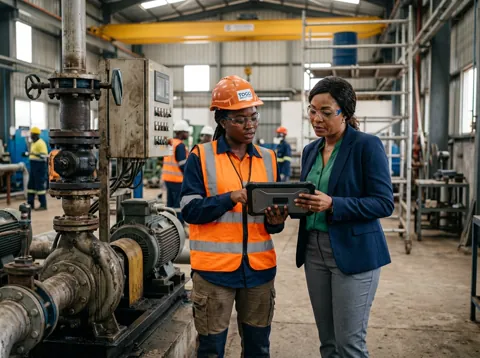
Needs discussion and analysis
With your managers, we review processes, difficulties and needs to define a suitable scope.

Contract
Scope, commercial terms, responsibilities and working arrangements are agreed before the project starts.
 Train the Trainer
Training the designated lead
The designated lead learns MatxFlow in order to train and support the users across the organization.
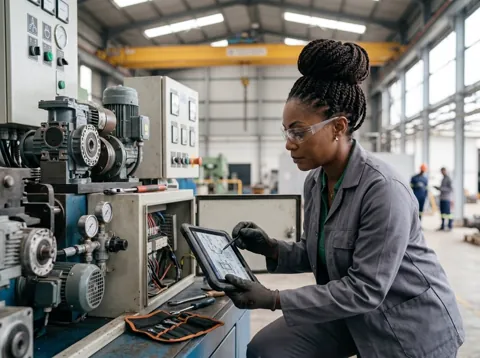
Operational deployment
Set-up within the agreed scope: environment, configuration and support for the first users.

Follow-up and continuous improvement
Monitoring usage, gathering feedback and identifying difficulties, for lasting adoption.
Illustrative images generated by AI.
Let's see how MatxFlow can fit into your maintenance.
Tell us about your organization, your equipment and your main tracking challenges. We can show you the relevant MatxFlow features and discuss how well they fit your operations.